Darien committee tables conservation easements project
The Darien Conservation Committee voted unanimously to table its conservation-easements inventory project and focus on redesigning the town's conservation governance.
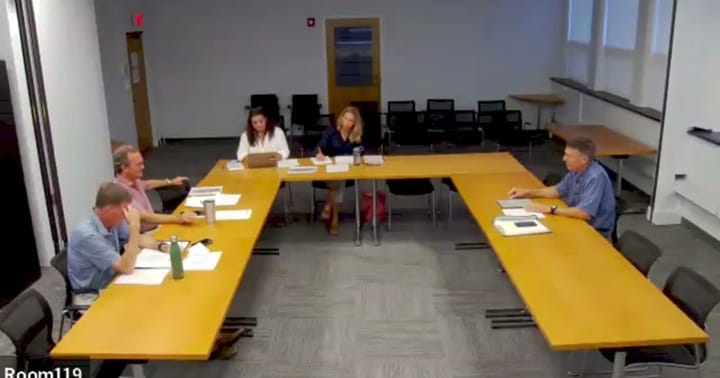
Conservation · Meeting of September 3, 2026
DARIEN — The Darien Conservation Committee voted unanimously to table its conservation-easements inventory project and focus on redesigning the town's conservation governance. Members compared Darien's single conservation staffer, named only as Rick, against Fairfield's eight-and-a-half-person department, which processes 200 to 300 Inland Wetlands applications a year, and New Canaan's leaner two-staff, volunteer-driven model built on close partnership with its land trust. One member said comparable towns spend "$300,000 to $1,300,000," averaging $600,000 to $700,000 annually on conservation, far above Darien's current spending.
The committee is also tracking Stamford's live effort to split its combined conservation and wetlands commission, recommended by a land use board on July 22 and now before that city's Representative Town Meeting amid "a lot of pushback" tied to housing-versus-conservation debates. Each member agreed to draft an individual proposal, or "straw man," model ahead of the committee's next session.
In the full story:
- Who Was There
- Organizations And Documents Referenced
- The complete report — 2,802 words
Source: the Conservation meeting of September 3, 2026, reported from the official video recording and transcript.
Checked against the record: before publication this article was automatically compared with the meeting transcript. It was corrected where it differed.
The Full Article
Procedural Reminder: FOIA and Meeting Decorum
The meeting opened with a reminder, prompted by what a member described as "an admonition from the administrators here on FOIA," that committee members should avoid discussing committee business outside of public meetings, including in email chains or texts among more than two members. One member acknowledged being "guilty myself" of informal banter meant to advance the group's work and said the reminder was a useful check given the committee's brainstorming style. The exchange did not produce any action but set the tone for a meeting members repeatedly described as a working session rather than a decision point.
Conservation Easements: An Unfinished Inventory
Background and stakes: Darien holds dozens of conservation easements, legal agreements restricting development on specific parcels, but has no centralized, searchable inventory of them. Two members who researched the issue said official easement records are held at the town clerk's office but cannot be sorted by category; records from 1969 to 2008 are indexed but not digitized, and anything older must be searched manually in property books. A separate paper file held by the planning department contains two boxes: one for Darien Land Trust-owned properties and one for town conservation easements, totaling roughly 70 to 80 folders.
The question before the body: whether the committee itself should undertake a records-digitization project ahead of any formal commission being established, and if so, how.
Substantive content: Members estimated the planning department's paper files might represent about 80 percent of the town's actual conservation easements, a figure described explicitly as "a guess." They discussed cross-referencing those files against the town clerk's searchable records database, which currently allows only a generic "easement" search that would also return utility, sewer and water easements. One member suggested the Darien High School environmental club could supply a summer intern to do the digitization, modeling the approach on the Darien Land Trust's own project. Executive director Elizabeth Mathis reportedly told a member that the Land Trust's digitization effort took about six months using two student interns, after an internal gap analysis of its own historical files. The town clerk's office has separately used a summer intern for general digitization, members said.
The deliberation: Members debated whether the records project was within the committee's current scope. "What are we trying to do with this?" one member asked, noting the records project was "a side task" running alongside the committee's main work of recommending a governance structure. Another member cautioned that even if an inventory were built, no entity currently exists to act as steward: "So if we do this prior to having an established conservation commission or whatever we're going to have, who would we be reporting that to? ... Short answer is no."
Procedural steps and outcome: The chair called for "a formal vote" on whether to table the records project while the committee focused on its structural recommendation. The vote passed unanimously, with the chair noting, "so call that a unanimous," and members agreeing to revisit the project "perhaps in early spring, gearing it for interns."
Implications and what is next: The records project is shelved, not abandoned. Any future conservation commission would inherit an unfinished, partly digitized set of easement records, and the committee signaled it may pursue the project again once a governance structure and staffing model are in place.
Learning from Fairfield: A Centralized Staff Model
Background and stakes: As part of a broader benchmarking effort, committee members have been interviewing conservation officials in nearby towns to inform a recommendation on how Darien should structure its own conservation function, which currently sits inside a combined commission alongside Inland Wetlands regulation.
The question before the body: what can Darien learn from towns that have already built out conservation staff and programs.
Substantive content: A member reported interviewing Tim Bishop, who leads a centralized conservation department in Fairfield. That department has eight and a half full-time employees and is responsible for Inland Wetlands regulation, conservation and a shellfish commission function, as well as stewardship of roughly 1,300 acres of town-owned land, which the member compared to an "embedded land trust." Of the department's staff, four are dedicated to land stewardship and four manage Inland Wetlands and conservation casework. Bishop told the member that roughly two-thirds to three-quarters of the department's work is processing Inland Wetlands applications, which run 200 to 300 per year; members said Darien's volume is "less than a hundred," with one member recalling a lower figure and expressing surprise at the comparison. Fairfield also employs a dedicated grant manager within its finance department who, according to the member's account, can raise "a couple million bucks a year in grants alone," with roughly 15 percent of grant funds covering administrative overhead.
The deliberation: Members weighed whether Fairfield's model, with its heavier staffing and broader land-management mandate, was transferable to a town the size of Darien. "I came out of the Fairfield meeting going, that's the model. We should duplicate that," one member said, before noting a competing impression from New Canaan. Another member observed that Fairfield's history, land holdings and twice-or-triple size relative to Darien explain much of its staffing, cautioning against a direct transplant of the model.
Procedural steps and outcome: No vote was taken; the Fairfield interview was treated as one data point feeding a future recommendation.
Implications and what is next: Fairfield's grant-manager role in particular resurfaced later in the meeting as a possible funding mechanism Darien currently lacks.
Learning from New Canaan: A Volunteer, Partnership-Driven Model
Background and stakes: New Canaan offers a contrasting structure to Fairfield's, with conservation and Inland Wetlands kept as separate commissions, minimal staff, and heavy reliance on partnership with a local land trust.
The question before the body: how a lighter-staffed, advisory-only model functions in practice, and what tools it uses to get things done without regulatory authority or significant paid staff.
Substantive content: Members reported separate conversations with Tom Cronin, head of New Canaan's Conservation Commission; Robin Bates Mason, a former head of that commission now leading the New Canaan Land Trust; and Kathleen Holland, the administrator for New Canaan's Inland Wetlands function. New Canaan's conservation and wetlands commissions have entirely separate memberships and responsibilities, supported by just two staff members, with no staff dedicated specifically to the conservation side. The conservation commission's chair sits as an ex officio member of the Land Trust's board, and the Land Trust reports to the commission at least once a year on joint or separate initiatives, a practice members said builds public awareness. Cronin's advice, relayed by a member, was to "look carefully at the statutes" and build flexibility into any founding charter so the commission's scope can expand as community priorities around conservation evolve, as New Canaan's own commission has done by taking on sustainability and recycling initiatives not explicitly listed in state statute. New Canaan operates under a town charter and ordinances approved by its town council, and Cronin described working toward incremental ordinances that convert advisory "may" authority into enforceable power over time, using committees of volunteer "single sector enthusiasts" that report up to the full commission before recommendations go to the town council.
The deliberation: One member summarized the trade-off bluntly: "And I came out of the New Canaan meeting and go, oh, that's the model," underscoring that the committee had not yet settled on which approach, or what blend of the two, fits Darien. Another member noted that New Canaan's conservation commission maintains close working ties with nonprofits, with information from groups such as the Land Trust funneled directly into public commission meetings, a form of information-sharing members said Darien currently lacks.
Procedural steps and outcome: No vote was taken. Members agreed the New Canaan interviews were especially useful because they came from commission leadership rather than only staff.
Implications and what is next: The committee flagged New Canaan's ex officio board seat and annual reporting arrangement with its land trust as a specific mechanism it may want to recommend for Darien, where several members said the existing relationship between Town Hall and local nonprofits like the Darien Land Trust is informal.
Watching Stamford: A Live Test Case for Splitting Conservation from Wetlands
Background and stakes: Stamford is currently attempting to separate its combined conservation and Inland Wetlands commission into two bodies, a live process members said is directly relevant to Darien's own deliberations.
The question before the body: what Stamford's experience suggests about the political and procedural path for separating conservation functions from a combined board.
Substantive content: A member reported that Stamford's land use board recommended on July 22 that the separation proposal advance to the city's Representative Town Meeting, which has since opened a public hearing period; a vote would follow the hearing. Materials from proponents stress that any new Stamford conservation commission would remain advisory only, without regulatory power, in an effort to ease opposition. Despite that framing, members said the proposal "gotten a lot of pushback amongst the populace," tied to broader housing-versus-conservation tension, with some residents framing conservation commissions as an obstacle to needed housing development.
The deliberation: Members debated whether that tension is inherent or avoidable. "Conservation is important to the town. There has to be a way to balance... the needs of the town from a conservation perspective, needs for growth and housing," one member said, adding that environmentalists have sometimes earned "a bad rap" for being reflexively obstructionist. Another member argued Darien's development is largely already built out, making the debate less about stopping growth than about designing it well going forward.
Procedural steps and outcome: No vote was taken. Members said they had not yet identified or interviewed the Stamford commission members or the residents pushing for separation, though one member said they had contact names for advocates on that side and offered to share them.
Implications and what is next: Stamford's RTM public hearing and eventual vote were cited as a process members intend to continue monitoring as a real-world precedent before finalizing their own recommendation.
Funding Gaps and Grant Strategy
Background and stakes: Both Fairfield's Tim Bishop and New Canaan's Tom Cronin reportedly identified funding, specifically a lack of grant-seeking capacity, as a gap in their own operations, prompting discussion of whether Darien should build that capacity from the start.
The question before the body: what funding mechanisms, beyond the town's general budget, could support an expanded conservation function.
Substantive content: Members discussed state and federal grants, which carry heavier compliance burdens, versus private foundation grants, described as "easy compliance." They noted many foundation grants require a local cost-share, often around 50 percent, citing a past Darien Land Trust land acquisition in which state, Connecticut and private funders required substantial town or trust co-investment before contributing. One member referenced a now-uncertain seminar series, run by a group members described as focused on "sustainable and resilient" municipalities, that had taught towns how to write grants, and suggested revisiting it.
The deliberation: One member argued the town has left money on the table for years: "I've seen various grant opportunities come and go through the last decade or so," while another pointed to Fairfield's self-funding grant manager model, whose salary and overhead are covered by the grants raised, as evidence the investment could pay for itself.
Procedural steps and outcome: No vote was taken; the discussion fed directly into the later budget conversation.
Implications and what is next: Grant capacity emerged as a likely element of any funding request the committee eventually brings forward.
Framing Darien's Own Model: Definitions, Budget and Staffing
Background and stakes: With benchmarking underway, members used the back half of the meeting to begin sketching what a Darien-specific model might look like, including how to define "conservation" itself.
The question before the body: what structure, definitions and resources the committee should propose, and how members should individually prepare for the next session.
Substantive content: Members discussed building the recommendation around a short list of priority concepts, floating terms including watershed, education, easements, greening new development, sustainability and climate resiliency, and debated whether Darien's vocabulary around "watershed" in particular is underdeveloped given the town's coastal and river geography. On staffing, a member presented comparative data from nine area towns, noting it was "a couple years old": average dedicated conservation staffing across those towns is three to four people, compared with Darien's single staffer, described as Rick, whom members said currently has no additional support. Budgets across those towns ranged from $300,000 to $1.3 million, averaging $600,000 to $700,000, a figure one member said would be almost entirely unfamiliar in Darien's current spending pattern. Members also discussed the Five Mile River Commission, a regional body with narrow but real regulatory authority over mooring placement, as an example of a town-adjacent body with actual enforcement power, unlike Darien's advisory-only committees.
The deliberation: One member framed the core choice sharply: "We need smart that has an eye towards conservation," while another cautioned against requesting funding without first identifying the specific problem it would solve: "Anything that we put up, we have to know the why. Can't just say we want a budget of half a million bucks." Members also discussed whether any new structure requires paid staff at all, noting New Canaan manages without a dedicated conservation staffer while still achieving recognition and partnership outcomes.
Procedural steps and outcome: No vote was taken. Members agreed each would draft an individual "straw man" model before the next meeting, built around a stated problem, a benefit to the town, and the relevant state-statute "may" and "shall" language, to be compared and merged at the following session.
Implications and what is next: The committee's eventual recommendation is expected to go first to the Board of Selectmen and, if advanced, to the Representative Town Meeting, where members said a town committee currently chaired, according to one member's recollection, by David Bain (with Frank Kemp previously in that role) would likely convert any recommendation into a formal ordinance.
Scheduling the Next Session
After roughly 20 minutes of back-and-forth over personal schedules, holidays and a member's wedding anniversary, the committee settled on September 16 at 5 p.m. for its next meeting, with the agenda to include each member's individual draft model and any additional town-interview results.
WHO WAS THERE
Committee members present and speaking in the transcript, by first name only (no roster was provided for verification): Jay, Stein, Bill, Peter, John, and at least one additional unidentified member who appeared to chair the meeting. Town staff referenced but not confirmed present: Rick, described by members as the town's sole dedicated conservation staffer; no surname or formal title was given in the transcript. Individuals referenced as contacted outside the meeting, not present: Jeremy (met with regarding easement records, no surname or title given); the Darien town clerk (not named); Alexis (a contact regarding outreach to Norwalk, no surname or role given). Outside officials discussed via prior interviews, not present at this meeting: Elizabeth Mathis, executive director of the Darien Land Trust; Tim Bishop, head of Fairfield's conservation department; Tom Cronin, head of New Canaan's Conservation Commission; Robin Bates Mason, head of the New Canaan Land Trust and former head of its Conservation Commission; Kathleen Holland, administrator for New Canaan's Inland Wetlands function.
ORGANIZATIONS AND DOCUMENTS REFERENCED
Darien Land Trust — cited for its own six-month records-digitization project and as a potential partner on easement record-keeping and public education. Darien Town Clerk's Office — holder of official conservation easement records; discussed as the authority on what is legally required to be preserved. Darien Planning Department ("PNC" in the transcript) — holds paper files of roughly 70 to 80 conservation-easement-related properties referenced in the easements discussion. Fairfield Conservation Department — benchmarked model with centralized staff, cited by a committee member's interview with Tim Bishop. New Canaan Conservation Commission and New Canaan Land Trust — benchmarked model with separated boards and nonprofit partnership, cited via interviews with Tom Cronin, Robin Bates Mason and Kathleen Holland. City of Stamford Land Use Board and Representative Town Meeting — cited as the body currently advancing, and the body currently hearing, a proposal to split Stamford's conservation function from its Inland Wetlands Commission; land use board action dated July 22. Darien Environmental Protection Commission (referred to as "EPC" in discussion) — Darien's current combined body housing both Inland Wetlands and conservation functions, which the committee is weighing whether to restructure. Five Mile River Commission — cited as an example of a regional body with narrow but real regulatory authority, used as a contrast to Darien's advisory-only conservation structure. Darien Library and Darien Nature Center — cited as existing community partners for conservation-related lecture series and education programming. Sustainable CT (referenced indirectly as a "sustainable and resilient" group) — cited for past grant-writing seminars for municipalities.
Share this story
Know someone in Darien who follows town government? Share Townbrief Darien: they can sign up free.