Board Approves Consent Agenda, Hears College Data
Darien's Board of Education reviewed Class of 2026 college admissions data showing application volumes nearly double the national average.
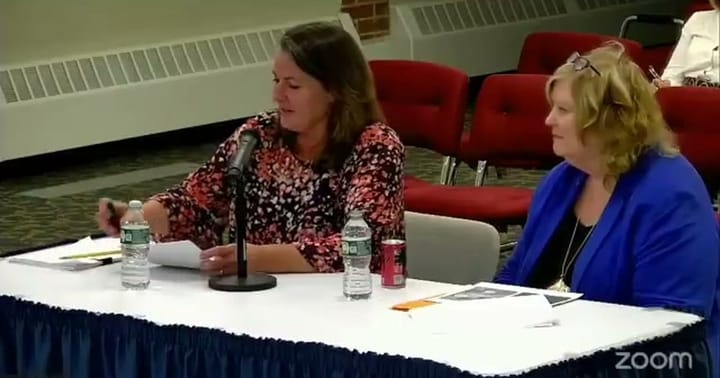
Board of Education · Meeting of September 8, 2026
Darien's Board of Education reviewed Class of 2026 college admissions data showing application volumes nearly double the national average. Director of Counseling Kathy Oster told the board the class of 360 students submitted 5,843 applications, an average of 14 per student versus a national average of seven, with 128 admitted through early decision, up from 98 the prior year. Board members Joanna and Dennis questioned why the district's report singles out Ivy League acceptance rates, with Dennis asking, "Why are we singling out the Ivies?" Superintendent Byrne said the practice is traditional but the district is "open to change." Oster said 94.4 percent of the class enrolled at four-year colleges and recent six-year completion rates for Darien graduates ran 83, 89 and 90 percent over three cohorts.
The board separately approved its consent agenda, including gifts for Hindley and Ox Ridge elementary schools, unanimously.
In the full story:
- Who Was There
- Organizations And Documents Referenced
- The complete report — 1,829 words
Source: the Board of Education meeting of September 8, 2026, reported from the official video recording and transcript.
Checked against the record: before publication this article was automatically compared with the meeting transcript.
The Full Article
Opening Announcements and Superintendent's Report
The meeting opened with routine scheduling announcements. Superintendent Byrne reported a smooth first full week of school, open houses scheduled across buildings the week of September 8 (elementary schools September 10, Middlesex Middle School September 14-16, Darien High School September 13), a 9/11 ceremony at Middlesex Middle School, finance committee meeting September 17, and the "Hindley Bash" event September 18. Byrne also promoted a weekly "Blue Spirit Day." None of this generated board discussion or action and is procedural in nature. Student representative Kylie gave a brief report on fall activities, sports schedules and the Theater 308 fall drama announcement; no board discussion followed.
DHS Class of 2026 Post-Secondary Plans: Background and Stakes
This agenda item is an annual report the counseling department gives each fall summarizing the prior spring's graduating class college outcomes and national admissions trends. Director of Counseling Kathy Oster said board members asked her last year to expand the report to address national trends more directly, which shaped this year's presentation structure. The question before the board was not a vote but a review: what happened with the Class of 2026's college applications and acceptances, and what should the district's counseling approach do differently, if anything, in response to shifting national patterns.
National Trends and Darien-Specific Data
Oster identified three national trends: continued "application inflation," a shift toward early application, and a renewed emphasis on standardized testing. She said the Common App reports national applications up more than 40 percent over five years, with students nationally averaging seven applications; Darien students average 14. Nationally, about 65 percent of applicants apply early action or early decision, matching Darien's pattern, where half the class submitted an early decision application and roughly half of all applications were some form of early application. Test-score reporting is up 11 percent nationally after several years of test-optional policies, a trend Oster said is also consistent in Darien.
Specific Class of 2026 figures presented: 360 students, average GPA 3.64, average SAT 1261, average ACT 30; 5,843 total applications submitted; 128 students admitted through early decision (up from 98 the prior year), including 28 recruited athletes (up from 16 the prior year); 94.4 percent of the class enrolled at four-year colleges, 1.7 percent at two-year schools; 10 students enrolled at international institutions outside the United States; South Atlantic region applications up 3 percent, roughly 11 students. Oster cited UConn as an example of high application volume relative to enrollment: 163 applications with nine students ultimately attending, a pattern she said repeats with Clemson, Indiana University and the University of Virginia, which she described as Darien's largest "application schools."
Mrs. Dunn, a DHS staff member who worked with Oster on the presentation, spoke about the Class of 2026's performance on the district's "vision of the graduate" competencies, reading excerpts from senior reflection essays and describing the class as strong leaders, noting two state lacrosse championships among the group's extracurricular record.
Board Deliberation: Testing, Athletics and the "Match, Not Prize" Framing
Board member Sarah asked whether SAT data could be presented as score ranges rather than averages, and separately asked about trends in athletic recruiting and whether recruiting volume is growing. Oster said she had figures specific to early decision: 28 recruited athletes among this year's 128 early-decision admits, versus 16 among 98 the prior year, calling it "a true trend."
Sarah also raised concern about the financial and psychological cost of unlimited applications under the Common App, describing unexpected application-fee credit card charges and asking whether there is a way to "educate students and parents" about application strategy. Oster responded that the office works to "take the temperature down" and encourage students to "trust the process," starting with college exploration as early as freshman or sophomore year.
"Because I think that what you just described about the [application] charge is panic. You know, and it's not, oh, hey, that would be fun. It's, oh my God, I'm working, I'm okay, and it's where I have to apply here." [00:27:41] — Oster, responding to board member Sarah
Board member Robin (referenced by Oster and other speakers but not separately quoted at length) suggested expanded guidance seminars and earlier Naviance orientation for parents, including simply driving past campuses during freshman and sophomore year to begin familiarization.
Board member Joanna raised the recurring question of why the report separates out Ivy League acceptance data when, she argued, Ivy admission functions essentially as "a lottery" given application volumes far exceeding available seats. Superintendent Byrne said he had discussed the question with Oster after last year's meeting and chose to retain the Ivy League breakout because it is traditional to the report, while saying the district remains open to changing the format. Oster added that the department does not emphasize the data internally but fields frequent questions about it from parents and community members.
Board member Dennis agreed with Joanna's critique of the Ivy League framing and pressed further on whether the district has a way to measure "what success looks like" in college applications beyond acceptance counts, proposing early decision rates as one metric and raising a second, unresolved question: whether the district tracks students who transfer out of their initial college choice, which he said would better indicate whether a "match" actually worked.
"And then my caveat on my nine years on the board, I think the other part that we should track is... what is the staying power of being at that school?" [00:37:35] — board member Dennis
Byrne responded that the district is beginning to use a Naviance link to the National Student Clearinghouse to study persistence, though usable six-year completion data only extends back to the 2020 cohort. She said recent completion rates for Darien graduates were 83 percent, 89 percent and 90 percent over the last three measured years, which she described as considerably above the national average, while cautioning that the data currently measures completion, not transfer patterns specifically.
Board member Bill asked whether the district could informally track whether graduates felt DHS prepared them academically for their chosen colleges' difficulty level, and separately asked whether early decision functions as a "demand signal" colleges weigh more heavily than other demonstrated-interest measures. Oster said admissions-rep conversations suggest early decision is increasingly viewed by colleges as the clearest demonstrated-interest signal, but cautioned that binding early decision commits a family financially and limits the exploration the counseling office otherwise encourages.
Board member Greg asked how much data analytics the counseling office applies to historical application and acceptance figures, citing specific numbers from the presented data, including nine students attending Clemson out of 63 accepted, four attending College of Charleston out of 35 accepted, and nine attending UConn out of 118 accepted, among others, and asked whether colleges might reduce acceptances of Darien applicants if yield (the share of accepted students who enroll) stays low. Oster said colleges are financially motivated to continue accepting high application volumes regardless of yield, since application fees generate revenue independent of enrollment outcomes.
Board member Sarah returned to raise what she called "the other elephant in the room": the prevalence of outside test-prep tutoring and private college consultants hired as early as freshman year. Oster said the counseling office does not track or coordinate with outside providers and does not have visibility into how many families use them, though she said the pattern is not unique to Darien and is common in comparable communities.
Joanna separately asked whether college admissions offices account for differences in high school rigor when evaluating transcripts, given Darien students' reported workload. Oster said she does not believe any college questions whether Darien students are prepared for college-level work, citing the district's Advanced Placement score profile sent with every transcript.
Kylie, the student board representative, offered a senior's perspective, suggesting the counseling seminar curriculum introduce Common App essay-question formats earlier, before the summer after junior year, and expand seminar discussion of non-college postgraduate paths such as military service or gap years.
Outcome and Next Steps
No vote was taken on the presentation itself; it was an informational report. Oster said the counseling office is adding parent programming aligned with seminar schedules: a senior-parent session September 18 (a PLC day), a freshman-parent session in November, with junior and sophomore sessions to follow in the third and fourth quarters. The Ivy League data-reporting question remains open for the board to revisit; Byrne indicated willingness to change the report's format for next year if the board requests it.
Consent Agenda and Adjournment
The board then took up its consent agenda, covering approval of the August 25, 2026 regular meeting minutes, acceptance of a gift from the Hindley Elementary PTO for a school mural, acceptance of a gift from the Ox Ridge Elementary PTO for outdoor picnic tables, and the personnel report. The chair noted a clerical clarification: the August 25 minutes had not listed a recorded vote tally, but the underlying vote was already recorded in the district's system and required no substantive change. Board member Dennis moved approval, seconded by board member Sarah; the board approved the consent agenda unanimously with no items pulled for separate discussion. No public comment was offered at either public-comment period. Board member Dennis moved to adjourn, seconded by board member Bill; the motion carried unanimously.
WHO WAS THERE
Board members present (first names only; surnames not stated in transcript, agenda, or any supplied document): Sarah, Joanna, Dennis, Bill, Greg. A presiding chair ran the meeting but was not named in the transcript. Staff present: Superintendent Byrne (surname only given; first name not stated in transcript); Kathy Oster, Director of Counseling, Darien High School; Mrs. Dunn, DHS staff member (title beyond "Mrs." not specified in transcript). Student representative: Kylie (surname not given). Mentioned but not present as speakers: Allison Mullane (assisted with presentation slide deck, title not given); Leslie LaJoy, administrative assistant, DHS counseling office; Laura Hyatt, administrative assistant, DHS counseling office. Public commenters: none; no public comment was offered at either comment period. Outside parties: none appeared before the board.
ORGANIZATIONS AND DOCUMENTS REFERENCED
Common App — cited by Director of Counseling Kathy Oster as the source of national application-volume trend data. National Student Clearinghouse — cited by Superintendent Byrne as the data source, accessed via Naviance, used to study post-graduation college completion and persistence. Naviance — the district's college-planning software platform, discussed repeatedly as a tool for both students/families and counseling data tracking, including historical acceptance data reportedly covering roughly the last 12 years. Darien High School Parents Association (DHSPA) — referenced by Oster as a group she met with regarding expanded parent programming. "Dream School" by Jeff Selingo — referenced by Oster as a book informing the counseling office's "match, not prize" philosophy. August 25, 2026 Board of Education meeting minutes — approved via consent agenda, with a procedural clarification about a previously unlisted vote tally already recorded in the district's system.
Share this story
Know someone in Darien who follows town government? Share Townbrief Darien: they can sign up free.